In the fast-paced chemical industry, market intelligence is often the key to strategic business decision-making. It enables companies to make sense of volatile market situations, finetuning their business strategies to remain competitive in the industry.
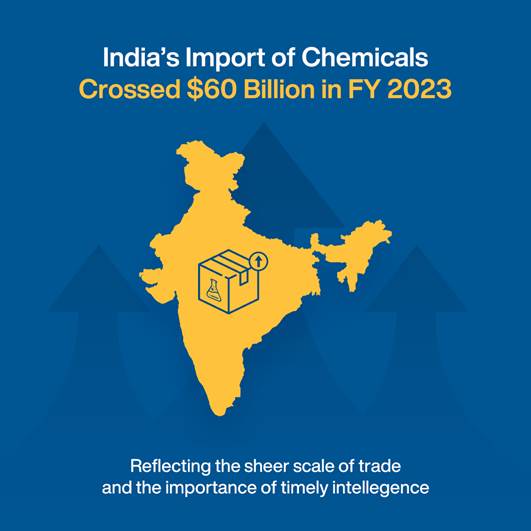
For those in the chemical industry or otherwise dealing with chemicals, it is pertinent to stay on top of raw material and specialty chemical prices, export-import activity, sustainability initiatives, and more. For instance, India’s import of chemicals crossed $60 billion in FY 2023, reflecting the sheer scale of trade and the importance of timely intelligence.
Especially in the case of chemicals, tariffs and trade regulations change fast- —with updates like China's tariff revisions or EU’s REACH compliance guidelines frequently altering the trading landscape. Chemical businesses must pay careful attention to these variables. needing careful attention from chemical businesses.
ALCHEMPro is the premier market intelligence tool for those dealing with chemicals. Whether it is daily raw material price updates or analyzing country specific import data, this tool is a one-stop solution for data gathering, monitoring, and analysis in the chemical industry.
Below we explore how market intelligence can help you make smarter trade and pricing decisions.
Why Chemical Companies Need a Market Intelligence Tool for Pricing Analysis?
Pricing analysis involves competitor benchmarking and consideration of the overall state of the market. Businesses must contend with the rapidly changing prices of raw materials like crude oil, propylene or acrylic acid. They also must contend with changing tariffs amidst the current global situation of escalating trade wars.
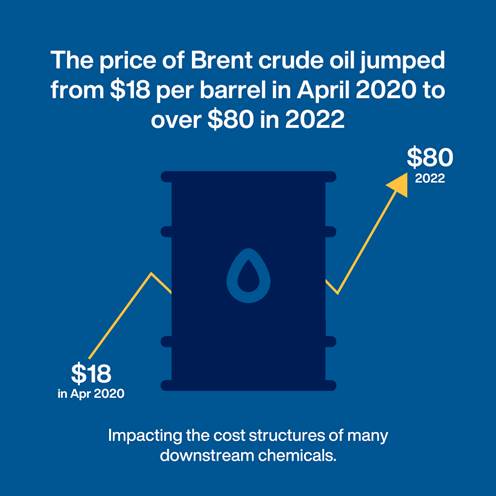
For example, the price of Brent crude oil jumped from $18 per barrel in April 2020 to over $80 in 2022, impacting the cost structures of many downstream chemicals.
Staying on top of raw material prices helps chemical businesses formulate pricing strategies. ALCHEMPro is the premier solution for this as raw material prices on the platform are updated daily, ensuring businesses don’t miss any shifts. The platform covers a wide variety of chemicals, including chloroform, sulfuric acid, groundnut oil, ammonia, magnesium chloride, acetone, methanol, castor oil, palm oil, super olein, mustard oil and many more—offering a 360-degree raw material snapshot.
How Market Intelligence Can Help Chemical Industry Professionals Make Data-Driven Decisions?
Market intelligence enables chemical industry experts to make informed decisions by converting raw data into actionable information. It offers a holistic perspective of
- Global supply chains
- Regulatory updates,
- Emerging Market Trends,
- Competitive Pricing Analysis
This enables proactive, data-driven decision-making.
For instance, if a manufacturer observes a rising demand in Asia-Pacific for specialty chemicals—a region that already holds over 40% of the global chemical sales—they can recalibrate production or sales focus accordingly.
Market intelligence also helps businesses:
- Identify growth opportunities in emerging markets
- Optimize product offerings
- Detect supply chain disruptions in real-time
- Negotiate more confidently with suppliers and distributors
Moreover, insight into energy consumption trends and sustainability benchmarks—such as BASF’s goal to achieve net-zero emissions by 2050—helps chemical companies align with environmental standards and build sustainability-focused policies.
This not only optimizes pricing effectiveness but also induces innovation through identification of unsatisfied customer needs and changing industry pressures.
Backed by data, businesses can also negotiate better with suppliers and distributors. Meanwhile, knowledge of sustainability measures and energy consumption patterns helps chemical companies craft their own sustainability policies.
Tracking Chemical Pricing Trends Using Market Intelligence Software
One of the biggest advantages of market intelligence is the ability to detect trends early.
For example, the 2014 crash in oil prices, which saw Brent crude fall from $115 to under $50 in six months, drastically affected downstream industries and economic activities in major countries like the US and China. Companies with foresight based on data avoided overproduction and excessive inventory costs. (source)
Chemical companies use market intelligence software to track changes in prices and make predictions for the future.
This helps businesses prepare for future increases and decreases in chemical prices. However, not looking at the data can leave businesses underprepared.
ALCHEMPro not only delivers up-to-speed raw material data but also has a vast store of historical data. By comparing historical prices with current ones, chemical businesses can glean pricing trends and make better forecasts, helping in strategy development. In addition, the tool provides its own forecast prices, simplifying the process further for users.
Future of Market Intelligence in the Chemicals & Allied Sectors
There is no lack of paucity in the chemical world when it comes to data. Going forward, the role of market intelligence will not be limited to just gathering data and making forecasts. Rather, chemical businesses are likely to look at market intelligence tools to organize data in a more straightforward manner.
To incorporate data into strategic decision-making, businesses need it presented in a palatable manner. Through the help of tools like charts, bar graphs, pie charts, and more, data is presented more succinctly.
AI is set to play a more pronounced role in market intelligence for the chemical industry going forward. For example, companies such as Reliance Industries Limited (RIL) and Tata Chemicals have already implemented AI in their working, whether it is to schedule maintenance or optimize production. This fascination with AI is set to extend to chemical market intelligence as well.
Conclusion: Why Market Intelligence Is a Must-Have for Chemical Businesses
Market intelligence tools help in optimizing pricing strategies, navigating complex trade regulations, and predicting market trends. Hence, the role of market research tools is important in fostering data-driven decision-making in businesses.
For chemical companies, ALCHEMPro is more than just a tool—it’s a strategic partner. From raw material tracking to import-export data analysis and pricing forecasts, it brings clarity to complex business decisions. The tool also presents data in a digestible manner, incorporating charts and excel sheets to help users. ALCHEMPro is also constantly updated and optimized, recently being made available in languages like Chinese, German, French, Spanish, Turkish, portuguese, making it a must-have for your chemical business going forward.