




20251208124546.jpg)


Introduction
Provence, a region in southeastern France bordering Italy and the Mediterranean Sea, has always had a flair for turning everyday life into something colourful, and its traditional folk dress is no exception. That’s the magic of the Provencal dress, an ensemble that feels as festive as a summer market in Aix-en-Provence. It has a way of instantly brightening a room, whether worn by a dancer, a festival-goer, or a proud heritage enthusiast.
What makes the Provencal dress so charming is the sense of joy stitched into every piece. The printed cottons are playful, the ribbons are cheerful, and the embroidery adds that irresistible handmade touch. It may look like something lifted straight from an old storybook, but it certainly wasn’t created for fairy tales. It was born from practical needs, blistering summer heat, and a keen regional sense of style that refused to be boring.
Although it has become an iconic symbol of Provence today, the dress originally emerged from the rhythms of rural everyday life. Women needed clothing that was light enough for the Mediterranean climate yet pretty enough to express individuality and local pride. Somehow, Provence, with its inherently optimistic spirit, managed to craft garments that were both functional and undeniably uplifting.
And so, the Provencal folk dress stands today as more than just a costume. It’s a living piece of cultural identity; a splash of sunshine preserved in fabric.
Scroll down to know more about the folk dress.
 The story of the Provencal dress begins in the 17th century, when southern France became a landing point for exotic printed cottons from India known as indiennes. These fabrics were unlike anything locals had ever seen: lightweight, brightly patterned, and far more comfortable than the heavy wool garments worn before. Provence fell head over heels for them, and the demand grew quickly. What started as imported luxury soon sparked an entire regional industry.
As these textiles gained popularity, local artisans began mastering the techniques of dyeing, block printing, and pattern-making. Workshops sprouted across the region, each adding its own spin to the vibrant motifs. By the 18th century, Provence had become a major centre for printed fabrics, producing patterns inspired by flowers, vines, and the geometry of traditional Indian design. These prints eventually evolved into the signature Provencal style we know today.
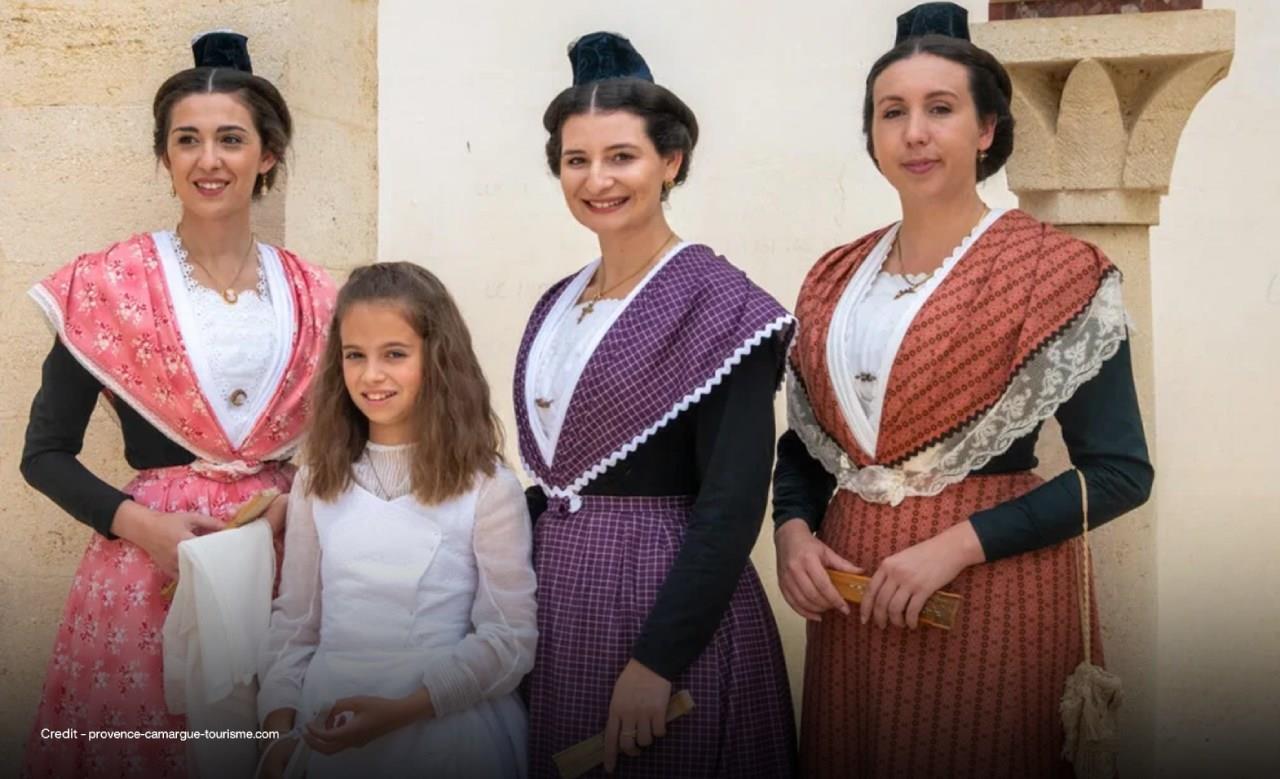
By the early 19th century, the silhouette of the Provencal dress became more defined. Women began wearing full, swirling cotton skirts paired with fitted bodices and triangular shawls called fichus. To complete the look, an embroidered apron was added, not only to protect the clothing but also to showcase personal style. These aprons became treasured items, often passed down through generations.
Even as modern clothing took over daily life, the Provencal dress refused to fade away. It found new purpose in festivals, folk dances, and cultural events where tradition is celebrated with pride. Today, it stands as a vibrant reminder of Provence’s textile history, artistic spirit, and enduring love for colour and craftsmanship.
Weaving Technique and Materials
 Provencal textiles are a sensory feast: smooth cottons with playful prints, subtle textures, and colours that feel like they were pulled straight from a sunrise. Traditionally, the fabrics were crafted using hand-loomed cotton, which offered both breathability and durability. Since Provence is warm almost year-round, heavy wool simply would not work. So, cotton became the region’s undisputed favourite for a reason.
Early Provencal prints were inspired by the floral and paisley motifs brought from India. Local artisans quickly learned to recreate these using wooden blocks dipped in natural dyes. Each block was carved by hand, etched with tiny flowers, vines, or geometric flourishes. When stamped repeatedly in careful rows, these patterns created the signature ‘boutis’ look associated with Provencal dresses. Many artisans also layered different blocks to achieve multi-coloured prints long before industrial techniques existed.
The embroidery on the aprons was just as significant. Women often decorated their own garments, choosing motifs that represented family traditions, natural landscapes, or symbolic protective charms. Threads were dyed using plants like saffron, woad, and madder giving the aprons that soft, earthy palette Provence is known for.
As production expanded in the 18th and 19th centuries, spinning wheels and looms became household staples. Weaving was not merely a trade but a domestic art. Young girls learned to stitch and embroider early, often completing their first full apron before they turned ten. Textile know-how was passed down like a treasured heirloom.
Today, some workshops still use traditional block-printing methods, though modern designs may rely on screen printing. Purists will insist that nothing compares to the crisp charm of hand-stamped cotton, and honestly, they are not wrong.
Cultural and Religious Relevance
 The Provencal dress isn’t just about aesthetics, though it certainly excels in that department. It carries cultural meaning that shifts subtly from village to village. For centuries, the clothing signalled a woman’s role, status, and even personality. A bright, bold floral skirt might hint at youthful playfulness, while a more subdued palette could suggest a mature woman who preferred tradition over trend.
Religious life played a significant role in shaping the design and use of Provencal attire. Feast days, processions, and church celebrations were major events in rural communities, and everyone dressed in their finest garments. Special dresses, sometimes with white shawls or gold-thread embroidery, were set aside for baptisms, Easter, or the Assumption. These pieces were handled with great care and often stored with lavender to protect the fabric.
Many motifs also held symbolic meaning. Certain flowers embroidered on aprons represented virtues like purity, fidelity, or abundance. Some families included discreet crosses or motifs meant to bring good fortune.
Folk beliefs were woven literally into every stitch. For women, especially in the 18th and 19th centuries, owning a well-adorned Provencal dress was a source of pride and a symbol of preparedness for important life milestones.
Community identity also blossomed around these garments. Even today, during regional fetes or folk dances, local groups wear slightly different cuts, colours, or aprons, each unique to its town or valley. It’s a friendly nod to history, a way of saying, “We belong here,” without uttering a word.
Though modern Provence is far more urban and eclectic, these traditions continue to weave through festivals, weddings, and cultural gatherings. The dress remains a vivid reminder that heritage isn’t something static; it’s something colourful to be worn with pride.
 Wearing a Provencal dress is not just about slipping into a skirt. It’s a layered ritual, and every piece plays a part.
At the base is a simple chemise, usually white, lightweight, and breathable. Over this comes the iconic full cotton skirt, often reaching the ankles and decorated with cheerful patterns or contrasting bands along the hem.
The bodice or corsage fits snugly, shaping the waist without restricting movement. It can be laced at the front or back and frequently features contrasting fabrics for visual interest.
To balance the structured bodice, a shawl called a fichu is draped around the shoulders. This triangular cloth protects from sun or wind while adding another splash of colour or pattern.
Then comes the star of the show: the embroidered apron. More than a protective layer, the apron is a canvas of artistic flair. Some aprons are simple, while others are extravagantly fringed or richly stitched. The way they are tied can differ from village to village. While some knots are purely functional, others are surprisingly decorative.
Accessories tie everything together. A straw hat, often flat-topped and tied with a ribbon, shields the wearer from the Provencal sun. Jewellery may include modest crosses or small metal charms passed down through families. And of course, the entire ensemble is worn with confidence, because if there’s one unwritten rule of Provencal fashion, it’s to bring joy into every step.
Modern wearers typically reserve the full outfit for festivals such as La Fete de la Saint-eloi or Les Fetes Provencales. But elements like the printed skirts and shawls still pop up in everyday life, blending old charm with modern style.
 One of the most delightful things about the Provencal folk dress is its wide variety. Depending on the region, one might see soft pastels, bold reds, deep blues, or sunshine yellows. Some villages favoured tiny floral prints, while others leaned towards geometric designs inspired by ancient trade influences.
The everyday dress was usually simpler, made of durable cotton with a modest apron and basic shawl. It was practical for household chores, market visits, or tending to crops. These pieces focused on comfort but still carried the unmistakable charm of Provencal prints.
Festival dresses, however, were a different story. They featured richer fabrics, more elaborate embroidery, and additional layers like lace collars or fringed shawls. Young women often wore brighter colours or new patterns chosen specifically for dance events and feast days. Married women typically opted for deeper hues and more conservative cuts, though this varied by village.
There were also special variations for significant life events. Wedding outfits, for example, included pristine white or cream shawls, sometimes enhanced with delicate gold threads. Christenings and religious processions inspired outfits that were more refined and symbolically aligned with the occasion.
Over centuries, these variations became a vibrant visual language. Even today, enthusiasts can identify a dress’s likely origin, from Arles to Aix to Avignon, simply by studying the fabric, apron style, and choice of embroidery. It’s fashion as storytelling, and Provence has mastered the craft.
 If someone wants to experience the magic of Provencal dressmaking firsthand, Provence offers a delightful trail of ateliers, museums, and workshops dedicated to the craft. Towns like Tarascon, Arles, and Aix-en-Provence have long histories of textile production, each developing its own flair for prints and embroidery.
Traditional indienne workshops, some still using 18th-century techniques, can be found throughout the region. These family-run operations preserve age-old printing methods, stamping cotton by hand and mixing dyes according to secret recipes passed down across generations. Visitors often describe the rhythmic sound of block printing as hypnotic and strangely joyful.
Museums such as the Musée du Costume Arlésien showcase beautifully preserved garments from past centuries, where visitors can marvel at lace shawls, embroidered aprons, and skirts whose colours have remained astonishingly vibrant. The displays not only celebrate fashion but also the women who created and wore these masterpieces.
Local artisans are also gaining recognition for reviving traditional methods with contemporary twists. Some create limited-edition fabrics inspired by historical patterns, while others specialise in hand-stitching aprons using motifs that blend old Provence with fresh creativity.
Travellers often stumble upon tiny boutiques tucked away in narrow lanes where artisans proudly demonstrate their craft. Whether they are watching dye being mixed or admiring an embroidered hem, the passion behind Provencal dressmaking is instantly contagious.
 Spotting an authentic Provencal dress requires a keen eye and a bit of textile sleuthing.
- The first giveaway is the fabric. True Provencal cotton has a certain crispness and breathability, with prints that look hand-designed rather than overly perfect or mass-produced. There are often slight variations in the pattern, an endearing sign of human craftsmanship.
- Next, look closely at the embroidery on the apron. Hand-stitched designs will have tiny inconsistencies, subtle irregularities, and thread tension that differs slightly from section to section. Machine embroidery, in contrast, appears too uniform and flat.
- Authentic garments also feature traditional cuts, full skirts, fitted bodices, shawls that match or cleverly contrast the main fabric, and aprons that harmonise without blending in too completely.
- Another sign of authenticity is the presence of natural dyes or naturally inspired colours. Older pieces have a soft, slightly faded charm, never the loud, synthetic brightness of modern mass-produced costumes. Even brand-new artisanal garments avoid neon tones in favour of earthy reds, sky blues, olive greens, and sunflower yellows.
- Finally, provenance matters. Authentic pieces usually come from workshops or makers known for traditional craftsmanship.
%20(1)20251211140147.jpg)


Comments